
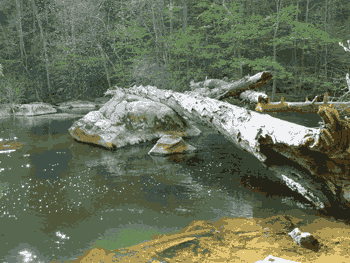
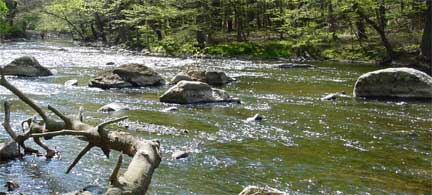
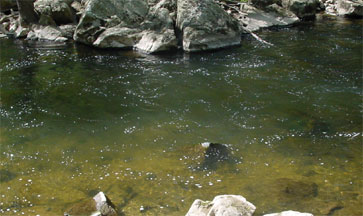
| Simply referred to as "The Gorge", it is one of the more respected trout streams in New Jersey. A majority of the water is fairly shallow, and most of the stream can be accessed with the help of waders. Other spots, like the one pictured below to the right, are deeper pockets that can be a few feet deep. |
 |
Home to primarily Brook, Brown and Rainbow Trout, The Gorge was a strictly fly fishing trout stream until 2002 when they allowed the use of artificial lures. Although you can now throw in a jig or spinner, the best method of catching a trout would still be a fly. The average size trout is anywhere from 8 to 12 inches, while a "keeper" trout is 15" and above.
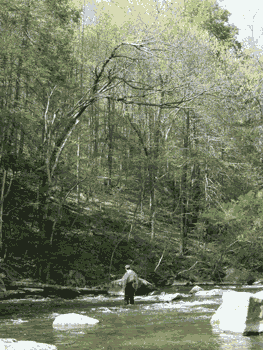
As more of a bass fisherman, The Gorge is always an interesting experience for me because of the fast moving current and rocky surroundings. The window of opportunity that a fish has to strike after a cast enters the water is very short, since your lure is swept down stream in a blink of an eye. Being my second trip to The Gorge, I still haven't gotten use to that part of it and only hooked one, which fell off after I treated it like a bass.
|
 |
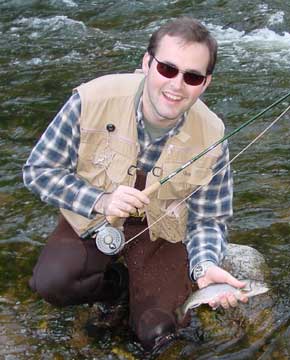 |
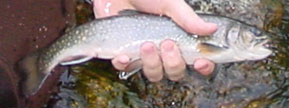
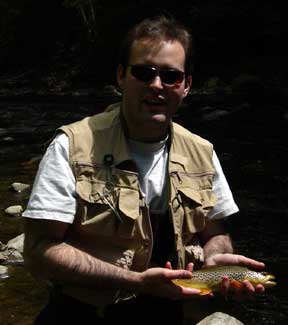
Jamie, on the other hand, knows these waters very well since he has fished them since he was a kid. From what he tells me, locating trout and presentation are key in catching them. Unlike bass, you cannot just toss bait in the water and hope they see it. Observing changes in current, knowing what trout are feeding on, and making the fly appear like the insect it is imitating all play a part. Since drifting a fly is such a great technique to use in this type of stream, movement is secondary. Jamie caught five Brown Trout out this outing; the last of which is pictured below.
|
The Gorge: Part 2
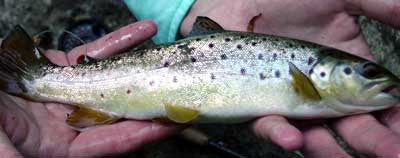
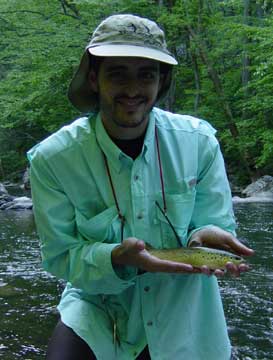
It's back to "The Gorge", as Jamie and Kregler return two weeks after the last visit to this beautiful stream. Brown trout were active again, even more so than the last time, but a nice rainbow trout and a sucker were also caught that day. Below, a close up of a young native brown trout which was caught by Kregler (Right).
|
 |
|
Q & A
Q: What makes them "native" brown trout, and how can you tell?
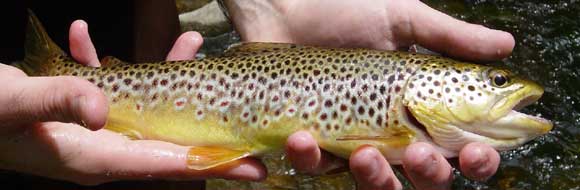
A: Native fish can be told apart by their more brilliant colors and their fins. Their more brilliant colors come from their all natural diet, as opposed to a hatchery fish which eats artificial foods: dry pellets. The fins on a hatchery trout will often be worn down, due to crowding up against tank walls, while a native trout, who swims freely in a stream, has fuller fins.
Whoa Momma! Check out the fins on that one!
|
A beautiful native brown trout caught by Jamie
|
Other Observations about Native Brown Trout
Jamie: the native browns seem to have wider spots than the other trout.
Mike: the native fish seem to be stronger fighters (especially the browns), maybe because they've lived their whole lives in water with current.
|
Suckers
Mike's expression says it all - Although a fun fish to have on your line, Suckers are, by no means, a "prize catch".
Mike: Yeah, they're sometimes called "trash fish," but since we don't aim to keep any, I'll take a few suckers. They don't usually hit flies, but they do make some nice runs due to their wide bodies. When you're fish doesn't jump, roll, or flash like a trout, it's probably a sucker .
Wow, Mike...what's with the crazy shirt?
Mike: My sister got this shirt for me from Cabelas. It's a great color that doesn't distract fish plus it has velcro straps to hold your rod if you're wading. It's a super shirt.
|
 |
 |
The Gorge: Part 3
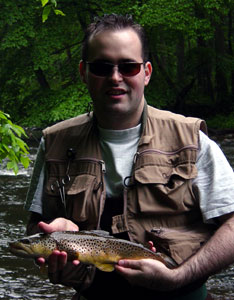
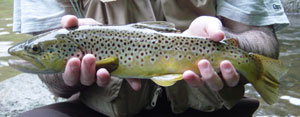
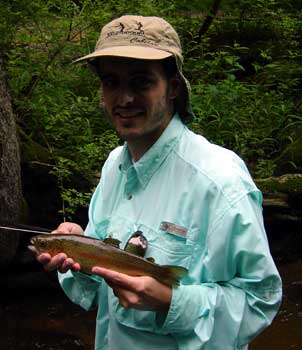
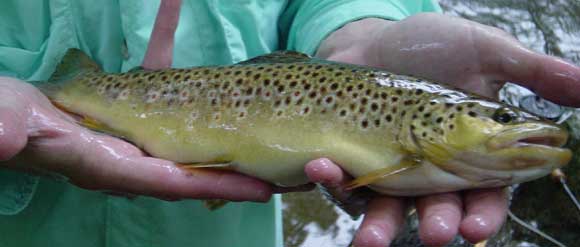
Once again, Jamie and Kregler fished "The Gorge" on a particularly rainy day on June 2nd. Although the weather wasn't cooperating, the fishing was a different story with many nice trout hooked throughout the day. Below and right is a very decent brown trout caught by Jamie.
|
On this outing, Kregler did very well with a nice rainbow trout and an equally nice brown trout. Although these fish made it to the site, there were nearly 20 fish caught between both fisherman that day.
During the month of May and continuing into June, New Jersey was hit with an unusually large amount of rain, like most of the country. This could sometimes be a disadvantage when fishing lakes and streams due to flooding and cloudy, murky waters. During these rainy spring days, it is good to see the fish still biting.
|
|
|